
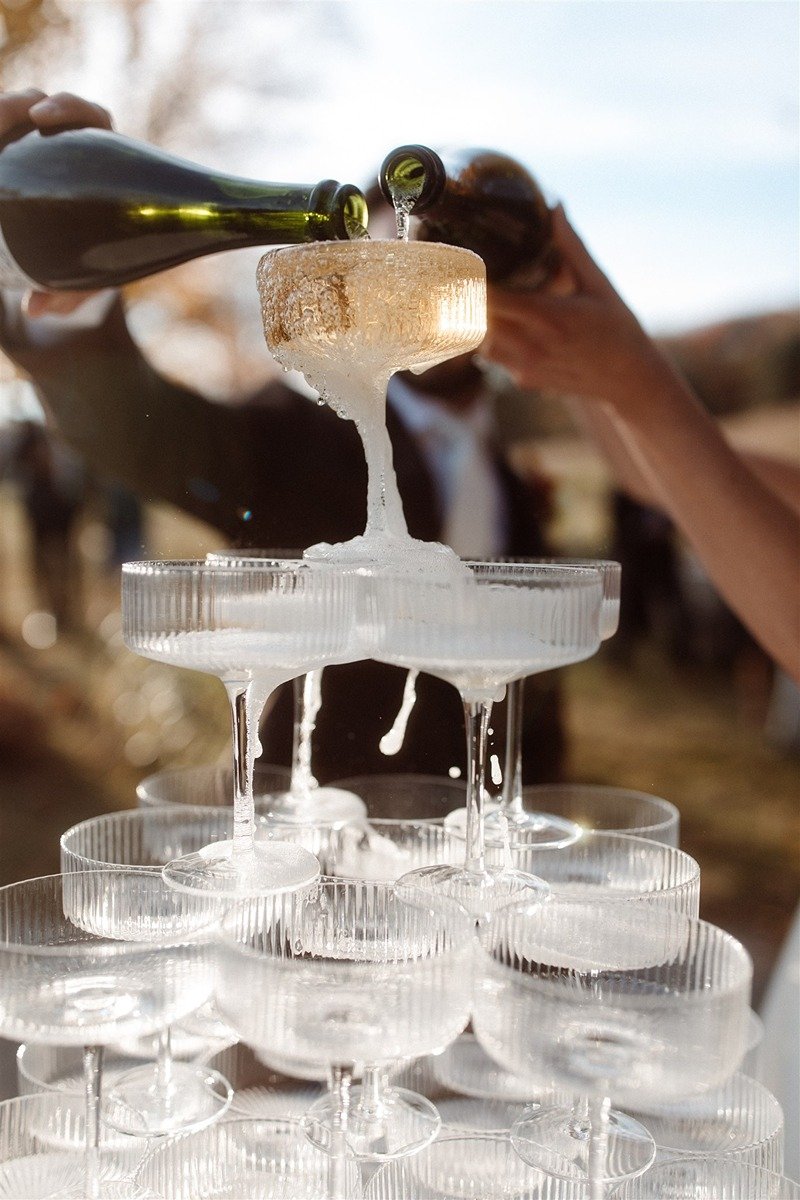
Champagne towers are one of those wedding details that people tend to have strong opinions about.
Some people see them as glamorous, fun, and very photo worthy.
Other people see them as messy, unnecessary, and a waste of money.
And honestly?
Both sides are a little bit right.
As a Hudson Valley Wedding Planner who has been planning weddings since 2010, I have seen Champagne towers done beautifully, awkwardly, practically, and in ways that made me think, “Well, that was pretty, but I hope someone brought towels.”
So let’s talk about it.
Are Champagne towers worth it?
Sometimes, yes.
Are they practical?
Not really.
Are they less wasteful than a traditional Champagne toast?
In my professional opinion, often absolutely yes.
First, What Is a Champagne Tower Really For?
A Champagne tower is not the most efficient way to serve Champagne.
Let’s just get that out of the way now.
If the goal is purely beverage service, your caterer can pour drinks at the bar much more easily, cleanly, and efficiently.
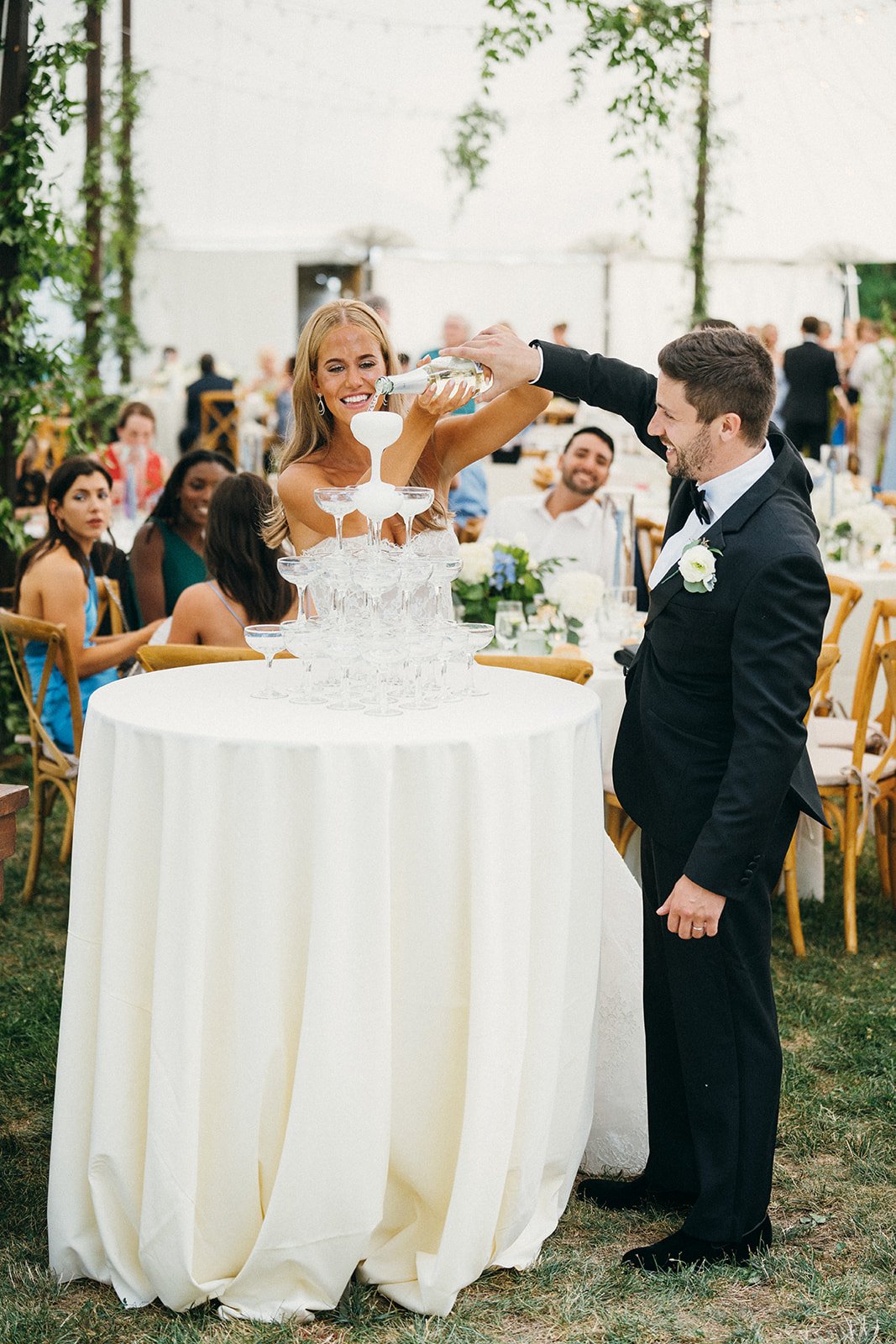
A Champagne tower is really about creating a moment.
It is:
A photo opportunity
A video moment
A reception focal point
A fun alternative to cake cutting
A way to create a toast without pouring Champagne for every guest
A little bit of wedding day theater
And I do not say “theater” as an insult.
Some wedding moments are meant to be beautiful, fun, and a little dramatic. That is part of the point.
Not every single wedding detail has to pass a strict utility test. Sometimes the question is not, “Is this the most practical thing we can do?”
Sometimes the question is, “Will this create a memorable, beautiful moment that feels worth it to us?”
Champagne Towers vs. Traditional Champagne Toasts
This is where I tend to get a little opinionated.
I have talked about Champagne toasts before, and I will say it again: traditional Champagne toasts are one of the biggest wastes of money I see at weddings.
Not because Champagne is bad.
Champagne is lovely.
The problem is how it is usually served.
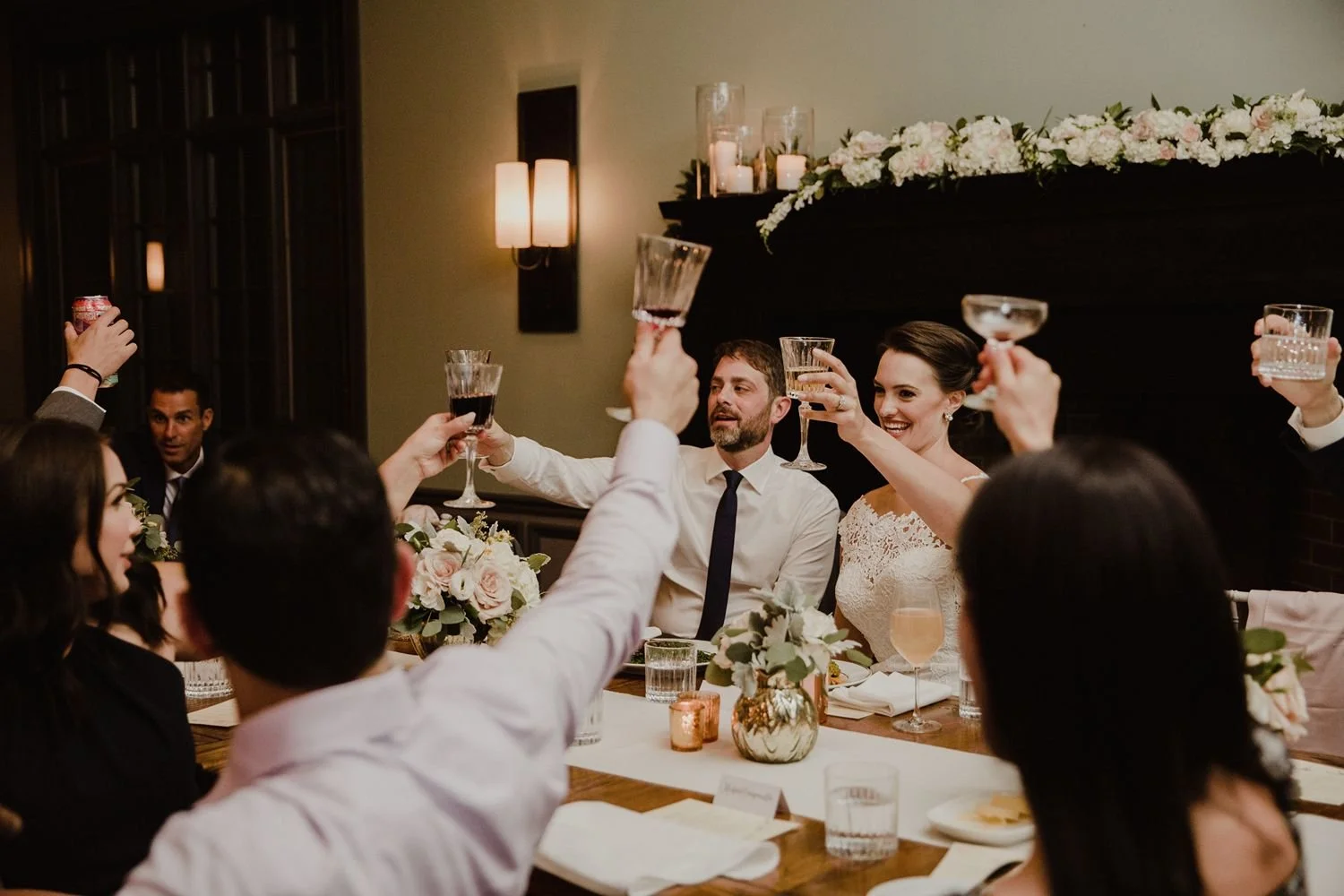
At many weddings, a glass of Champagne or sparkling wine is poured for every guest and placed at each table before speeches or toasts begin.
In theory, this sounds elegant.
In reality, a lot of guests already have a drink in their hand.
They have wine. They have a cocktail. They have a beer. They have whatever they were drinking when they walked into the reception space.
And when the toast happens, a large percentage of guests simply lift whatever is already in their hand.
Of the guests who do use the Champagne glass, many take one or two polite sips and then leave the rest sitting on the table.
By the end of dinner service, a huge amount of that Champagne gets dumped.
For a wedding of 150 to 200 guests, that can mean cases of sparkling wine poured, barely touched, and thrown away.
That is not a tiny little bit of waste.
That is actual money going directly down the drain.
What I Do Instead When Champagne Toasts Are Included

When caterers or venues include a Champagne toast in their package, one of the first things I usually ask about is whether we can shift that Champagne to a pre ceremony welcome station instead.
This is almost always a better use of the money.
Instead of placing Champagne at tables where it may sit untouched, guests are offered a glass as they arrive before the ceremony.
That usually works beautifully because guests are:
Just arriving
Looking for something to do
Happy to be welcomed with a drink
More likely to actually drink it
Not already holding another beverage
It feels generous and hospitable.
It creates a lovely first impression.
And most importantly, it is usually far less wasteful.
Guests appreciate a glass of Champagne when they arrive. It feels celebratory right away. It says, “Welcome, we are so glad you are here.”
That is money much better spent.
Why a Champagne Tower Can Actually Make More Sense
This is why I find the “Champagne towers are wasteful” argument a little funny.
Are they the cleanest, most practical thing in the world?
No.
Are they mostly for the photo?
Yes.
But compared to pouring Champagne for every single guest at their seat, a Champagne tower can actually be easier to justify.
A Champagne tower may only require a few bottles of sparkling wine, depending on the size of the tower and how full you are filling the glasses.
A traditional Champagne toast for a full guest count may require cases.
And with a tower, at least you get something memorable out of it:
A beautiful photo
A fun video clip
A reception moment
A toast opportunity
A detail guests actually notice
A modern alternative to cake cutting
So no, I do not think Champagne towers are always a waste.
I think they are a wedding detail that needs to be understood for what they are.
They are not practical beverage service.
They are a styled, celebratory moment.
And when planned correctly, they can be really fun.
When to Do a Champagne Tower
There are a few different times I have seen Champagne towers work well at weddings.
Option 1: During Cocktail Hour
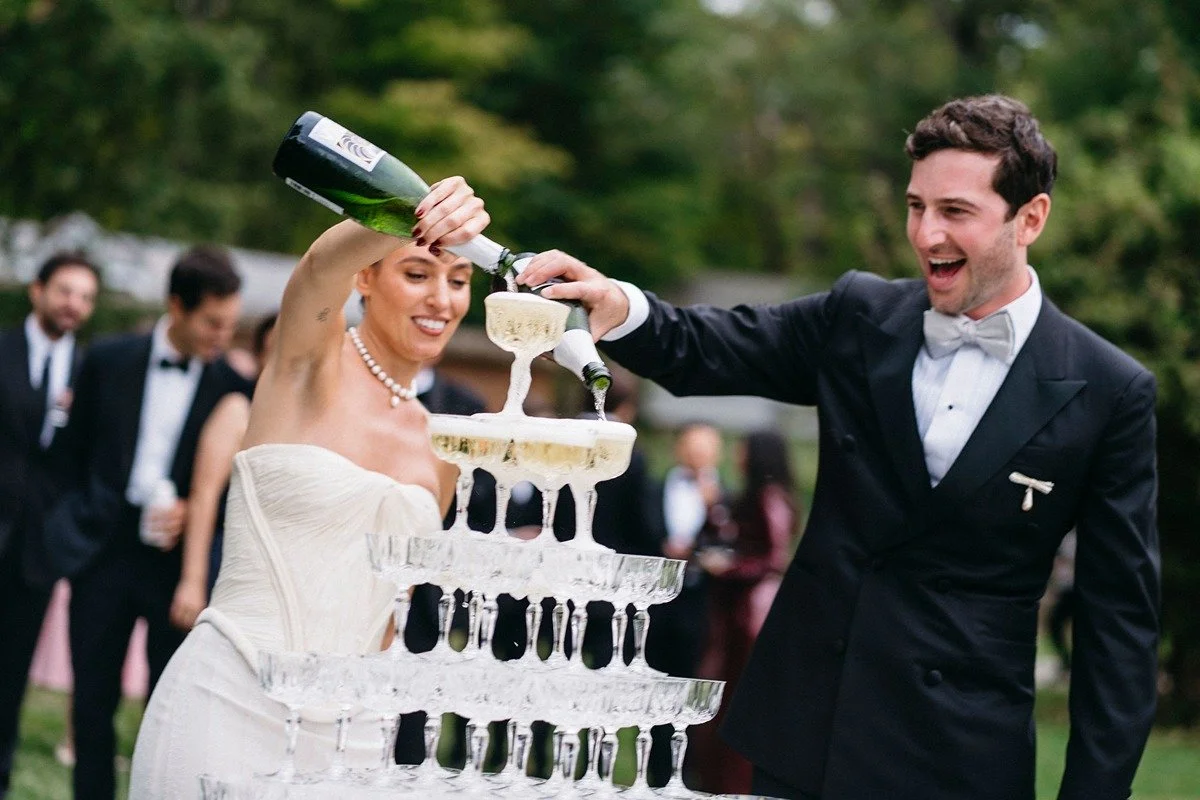
A Champagne tower during cocktail hour can be a great way to create an interactive guest experience.
At one wedding, we had four different Champagne towers set up throughout cocktail hour on different high top tables.
Catering poured Champagne into three of them, while the couple used the fourth one as their photo opportunity.
Afterward, the Champagne was handed out to guests who wanted it.
This worked because it was intentional. It was built into the cocktail hour experience, catering knew what was happening, and the couple still had their own photo moment.
Option 2: As an Alternative to Cake Cutting
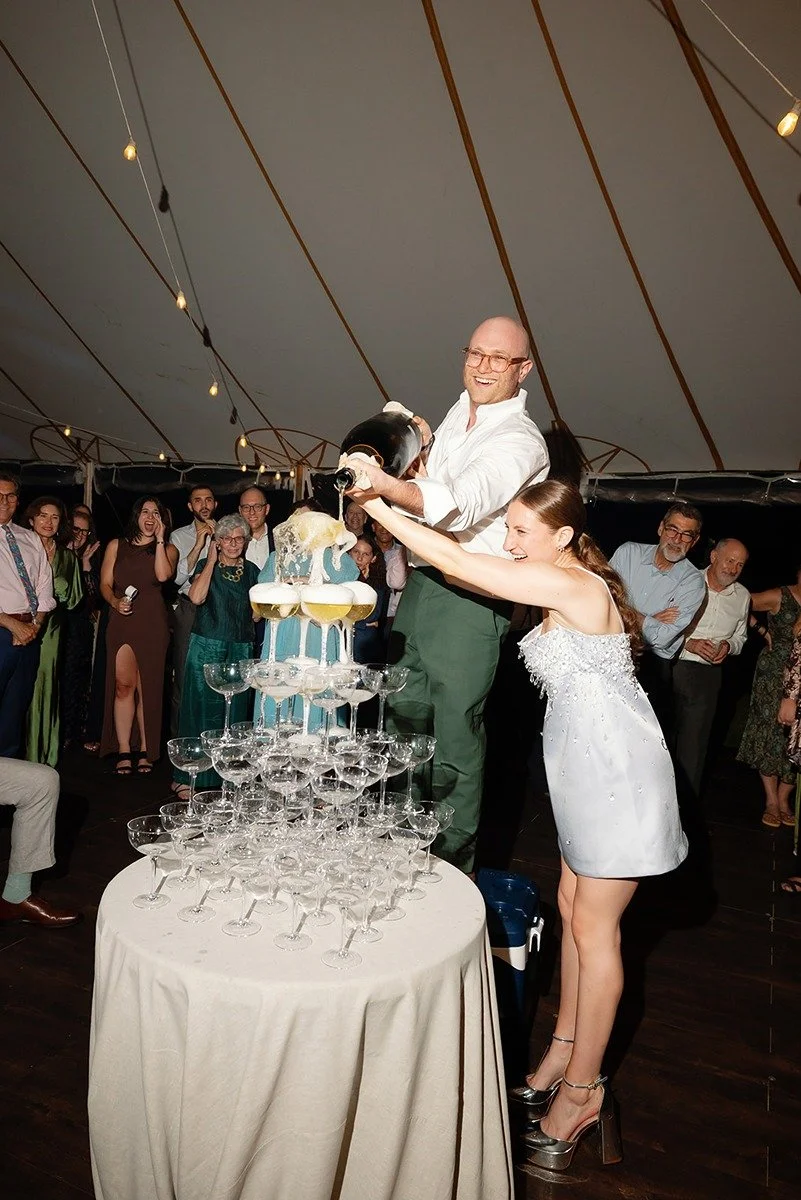
Fewer and fewer couples are excited about a traditional cake cutting ceremony.
Some couples still love it, and that is great.
But many are doing smaller cakes, dessert stations, passed desserts, or no formal cake moment at all.
A Champagne tower can be a fun alternative.
It gives you:
A formal reception moment
A photo opportunity
A natural reason to gather attention
A toast moment
A celebratory transition into the next part of the evening
If you want a “thing” to do, but cake cutting does not feel like you, a Champagne tower can be a great option.
Option 3: As a Reception Transition Moment
You can also use a Champagne tower to mark a transition in the evening.
For example:
After introductions
Before dinner
After speeches
Before dancing begins
At the end of cocktail hour
As a kickoff to the party portion of the night
The key is to place it somewhere in the timeline where it makes sense and does not interrupt the flow.
How Many Glasses Do You Need for a Champagne Tower?
I typically recommend a 55 glass Champagne tower, which is a five level tower.
Here is how that breaks down:
Bottom level: 25 glasses
Fourth level: 16 glasses
Third level: 9 glasses
Second level: 4 glasses
Top level: 1 glass
Total: 55 glasses
If you go up to a six level tower, the number jumps quite a bit.
A six level Champagne tower requires:
Bottom level: 36 glasses
Fifth level: 25 glasses
Fourth level: 16 glasses
Third level: 9 glasses
Second level: 4 glasses
Top level: 1 glass
Total: 91 glasses
That means adding “just one more level” actually requires 36 additional glasses.
That is a big difference.
It impacts the rental order, setup space, table size, beverage amount, and overall logistics.
Always Rent Extra Glasses
Please do not rent the exact number of glasses needed for the tower.
Just do not.
With rentals, glasses break. Glasses go missing. Glasses arrive with small differences, even when they are technically the same style.
And believe it or not, coupe glasses from rental companies are not always 100% identical in size.
They may be the same general glassware line, but slight variations happen. Those little differences matter when you are stacking glassware into a tower.
For a 55 glass tower, I would rent at least a few extra glasses.
If your rental company is known for substitutions or if you are using specialty glassware, rent even more.
This is not the place to cut it exactly close.
Use Coupe Glasses
Champagne towers should be built with coupe glasses.
Not flutes.
Not wine glasses.
Not whatever glassware happens to look cute on the shelf.
Coupe glasses have the shape needed for stacking and pouring.
You can choose a style that fits your wedding design, such as:
Classic clear coupes
Vintage inspired coupes
Gold rimmed coupes
Etched or patterned coupes
Modern minimalist coupes
Just make sure the glassware works structurally, not just aesthetically.
Pretty is important.
So is gravity.
The Champagne Should Be Chilled and Opened in Advance
This sounds obvious, but it needs to be planned.
The Champagne or sparkling wine should be chilled ahead of time.
Several bottles should be opened before the moment starts so the couple is not standing there awkwardly while someone wrestles with foil, cages, corks, and wedding day nerves.
This is one of those details that looks effortless when it is done correctly.
But behind the scenes, someone needs to be responsible for:
Chilling the bottles
Opening the bottles
Having towels nearby
Making sure the tower is ready
Handing the couple the bottle
Managing the cleanup afterward
A Champagne tower is not complicated, but it does need a plan.
What Happens to the Champagne Afterward?
This is one of the questions I get almost every time.
“What happens to the Champagne after the tower is poured?”
Great question.
There are a few options.
Option 1: Guests Take Glasses From the Tower
This can work, but everyone needs to understand that the glasses may be sticky.
When Champagne is poured down a tower, it does not gently and politely fill each glass without touching the outside.
It runs over the glasses.
It drips.
It splashes.
It gets everywhere.
That is part of the whole concept.
So if guests are taking glasses directly from the tower, they should expect the glasses to be a little sticky.
Option 2: Catering Wipes the Glasses and Sets Them at the Bar
This is something I have done before.
Catering can wipe the glasses and place them at the bar so guests can help themselves.
This is a little cleaner and more controlled than having guests pull glasses directly from the tower.
It does require staffing and a little time.
Option 3: The Tower Is Mostly for the Couple
Sometimes the tower is really just for the couple’s photo and toast moment.
The couple pours the Champagne, gets the photo, takes a sip, and catering clears the tower afterward.
That is perfectly fine too.
Again, the point is to decide this in advance.
Do not assume that the tower automatically becomes guest beverage service.
Champagne Towers Are Sticky
This needs its own section because it is important.
Champagne towers are glamorous in photos and sticky in real life.
Both things can be true.
You are literally pouring liquid over a stack of glasses.
That means:
The glasses will get sticky
The table will get wet
The linen may get soaked
The floor may need to be checked afterward
Towels should be nearby
Catering or venue staff should know cleanup is part of the plan
This does not mean you should not do it.
It means you should not be shocked when the thing involving cascading liquid creates a mess.
Choose the Right Table
The table matters more than people think.
You need something stable, level, and appropriately sized.
If the table is too small, the tower may not fit safely.
If the table is too large, the tower can look tiny and awkward, like it got lost on its way to the actual party.
The table also affects the height of the tower.
A high top table is usually around 40 inches tall. If you add a five level tower on top of that, you may be creating a very tall pour moment.
That can be fine for some couples.
But if the couple is shorter, or if one person is much shorter than the other, it can get awkward quickly.
A Champagne tower should make you look glamorous, not like you are trying to water a hanging plant.
For taller towers, especially anything over five levels, I usually prefer a standard height table.
Think About the Linen
Because the table is going to get wet, the linen choice matters.
A pretty linen can make the Champagne tower feel much more intentional and styled.
But this may not be the right place for a delicate, expensive, deeply sentimental, or hard to clean specialty linen.
You want the tower table to look special, but you also need to remember that Champagne may be dripping all over it.
Good options might include:
A linen that coordinates with the reception design
A slightly more elevated texture
A color that helps the glassware stand out
Something intentional enough to feel designed, but not so precious that everyone panics when it gets wet
Location Matters
A Champagne tower should not be placed randomly.
It should be somewhere that makes sense for guest flow, photography, and cleanup.
A good Champagne tower location should be:
On a level surface
Away from heavy guest traffic
Out of the way of children and enthusiastic elbow talkers
Easy for catering or bar staff to access
Well lit for photography
In a spot with a nice backdrop
Close enough to the action without being in the way
Remember, this is a photo moment.
If you are spending money on the tower, make sure the background is not a stack of dirty plates, a catering trash can, or the venue’s emergency exit sign doing its absolute best to be in every photo.
Put It in the Timeline
A Champagne tower should be listed clearly in the wedding day schedule.
Not vaguely mentioned.
Not casually assumed.
Actually scheduled.
Your photographer and videographer need to know when it is happening because it is a major photo and video moment.
Your planner or coordinator needs to know so they can gather the couple, check the setup, cue catering, and make sure the moment is captured.
Your catering team needs to know because they are usually the ones dealing with the glassware, Champagne, towels, and cleanup.
The timeline should clarify:
When the tower is built
Who is building it
When the Champagne is opened
When the couple is arriving
Where the photographer should be
Whether video is capturing it
What happens after the pour
Who clears the glassware
This is not the kind of detail you want everyone figuring out in real time.
Champagne, Prosecco, Cava, or Sparkling Wine?
Most couples call it a Champagne tower, but technically, it may not be Champagne.
It might be:
Champagne
Prosecco
Cava
Sparkling wine
What you use will depend on your bar package, caterer, venue rules, and budget.
For most weddings, guests are not going to be inspecting the bottle during the tower pour.
The bigger priorities are:
Is it chilled?
Does it pour well?
Does it fit the budget?
Is there enough?
Is someone managing it properly?
When a Champagne Tower Is Worth It
A Champagne tower may be worth it if:
You want a beautiful photo moment
You are skipping the traditional cake cutting
You want a modern toast alternative
You like reception moments that feel a little theatrical
Your photographer and videographer know when it is happening
Your caterer or venue team is prepared for setup and cleanup
You are choosing the table, linen, glassware, and location intentionally
If you love the look and understand the logistics, go for it.
When a Champagne Tower May Not Be Worth It
A Champagne tower may not be worth it if:
You only want it because you saw it on Pinterest
You do not care about the photos
Your timeline is already too packed
Your cocktail hour space is crowded
Your venue has limited staffing
You are very tight on rentals
You expect it to be a clean and efficient way to serve drinks
You will be upset by sticky glassware or a wet linen
That last one is important.
If mess stresses you out, this may not be your moment.
Final Thoughts From a Hudson Valley Wedding Planner
Champagne towers are not for every wedding.
They are not the most practical beverage service option.
They can be sticky, messy, and a little chaotic.
But when they are planned well, they can also be beautiful, fun, and incredibly photogenic.
The key is understanding what you are actually paying for.
You are not paying for the world’s most efficient drink service.
You are paying for a moment.
And if that moment feels like you, if it fits your timeline, your venue, your design, and your priorities, then a Champagne tower can be a great addition to your wedding day.
But if your venue or caterer includes a traditional Champagne toast in your package?
My planner advice is this:
Ask if you can shift it to a pre ceremony welcome glass instead.
Your guests will appreciate it more, you will likely waste less, and you will not be watching cases of sparkling wine get poured down the drain after one polite sip.
And if you still want that Champagne tower photo?
Even better.
Just make sure someone brings towels.